// hello, I'm

Logan Persyn

Computational Biologist & Machine Learning Researcher

PhD student at UT Austin building deep learning models of translation — decoding how an mRNA sequence controls protein output, and using that to engineer mRNA therapeutics.


// about me

Background

I am a PhD student in the Interdisciplinary Life Sciences program at the University of Texas at Austin, studying cell and molecular biology in Dr. Can Cenik's lab. My work sits at the intersection of machine learning and the biology of translation: I build models that learn how the sequence of an mRNA determines how much protein a cell makes from it. Learn more about the Cenik lab's research here.

I came to biology from computer science. I completed both a B.S. and an M.S. in computer science at UT Austin through the integrated BS/MS program, where machine learning and data science courses gave me the foundation I use every day — convolutional networks, transformers, and the linear algebra needed to reason about high-dimensional multiomics data.

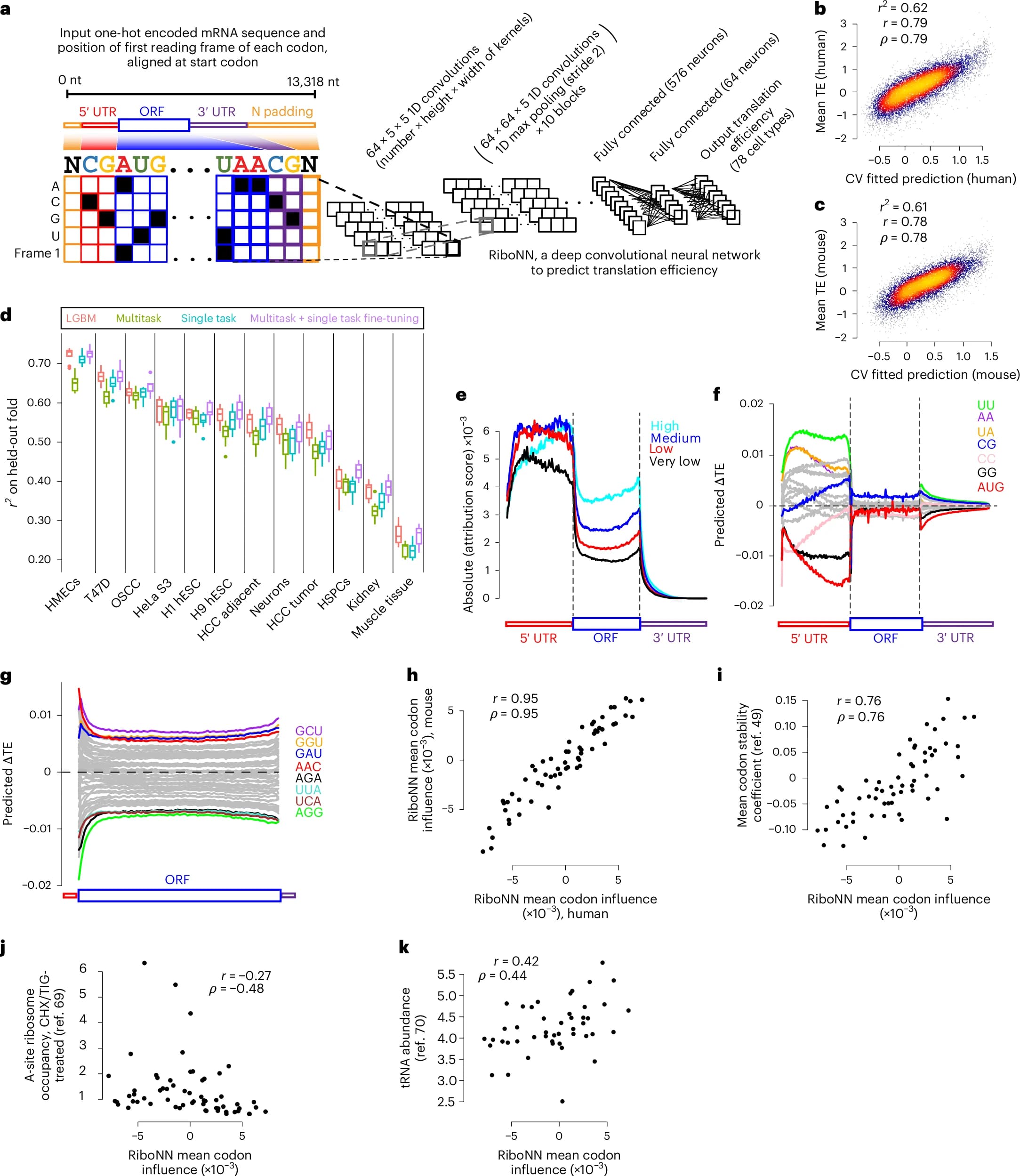
I joined the Cenik lab as an undergraduate in 2022 and have contributed to four publications since, including a co-first-authored paper in Nature Biotechnology showing that mRNA sequence alone is sufficient to predict cell-type-specific translation efficiency. I decided to pursue a PhD to deepen the biological side of that work and to learn to train much larger models on high-performance computing resources.

Outside of my own project, I co-lead the Biology and Machine Learning Society (BioML) at UT Austin, a vibrant community of researchers using machine learning to solve biochemical problems. Our mission is to accelerate progress in applying machine learning for biology by fostering interdisciplinary collaboration and engaging with the scientific community. BioML is always looking for new members, so if you're interested in learning more about the intersection of biology and machine learning, get in touch! More info about BioML can be found here.

Education

  1. Ph.D. in Cell and Molecular Biology

    May 2025 – May 2030 (expected)

    The University of Texas at Austin

    Interdisciplinary Life Sciences program · Cenik Lab, Department of Molecular Biosciences

  2. M.S. in Computer Science

    Aug 2023 – May 2025

    The University of Texas at Austin

    Integrated BS/MS program · Coursework in reinforcement learning, computer graphics, programming languages, algorithms, human-computer interaction, and ethics in AI

  3. B.S. in Computer Science

    Aug 2019 – May 2025

    The University of Texas at Austin

    Integrated BS/MS program · Coursework in machine learning, neural networks, natural language processing, quantum information, numerical analysis, and programming for performance

// research

What I Work On

Translation efficiency — the amount of protein a cell makes per mRNA — varies widely across cell types, and the sequence features that drive that variation are still poorly understood. I build deep learning models that learn those features directly from ribosome profiling data, then use those models to design mRNA sequences with the desired translation characteristics.

Current project

A deep-learning model of ribosome occupancy for engineering targeted mRNA therapeutics

Current models predict a single translation efficiency value per transcript. That summary obscures the positional information ribosome profiling actually provides, so the models cannot distinguish the sequence features that govern translation initiation from those that govern elongation — which limits how well they can be used to engineer tissue-specific expression. My central hypothesis is that an accurate nucleotide-resolution model of ribosome profiling data can be exploited to engineer mRNAs with cell-type-specific protein output. Computing resources provided by the Texas Advanced Computing Center (TACC).

Nucleotide-resolution modeling CNN + Transformer Ribosome profiling mRNA design PyTorch High Performance Computing
Aim 1

Identify the sequence determinants of cell-type-specific translational control

I am training a convolution- and transformer-based model to predict per-nucleotide ribosome footprint density and RNA abundance directly from sequence, across a curated atlas of 78 human and 68 mouse cell types, using multi-species data as a form of evolutionary regularization. Two attribution methods — in silico mutagenesis and integrated gradients — will be used to extract the sequence grammar the model learns, and predicted variants will be tested experimentally in luciferase reporter constructs across multiple cell lines.

  • Nucleotide-resolution Ribo-seq and RNA-seq prediction
  • Resolves initiation from elongation
  • Model and trained weights released publicly
Aim 2

Design and validate therapeutic mRNA with optimized cell-type-specific translation

Using gradient-based optimization over the trained model, I will design coagulation factor VIII (F8) mRNA variants — synonymous substitutions and UTR sequences — predicted to maximize translation in liver-like cells, where F8 is endogenously produced, while minimizing translation in immune cell contexts to reduce immunogenic risk. Top-ranked designs will be delivered by lentiviral transduction and validated by protein quantification and chromogenic coagulation activity assays, benchmarked against the endogenous sequence and existing codon-optimized designs.

  • Hemophilia A as the model system
  • Hepatocyte and myeloid cell lines
  • A template intended to generalize beyond F8

Prior Contributions

Predicting cell-type-specific translation efficiency from sequence. Prior computational approaches modeled translation efficiency as a cell-agnostic quantity. Working from a manually curated dataset of 2,277 published RNA-seq and ribosome profiling experiments, our lab identified translationally co-regulated genes and showed that genes sharing covariation patterns share biological function. I then helped build and benchmark a convolutional deep learning model demonstrating that mRNA sequence features alone predict cell-type-specific translation efficiency with high accuracy. I trained and compared the linear, random forest, and gradient-boosted baselines against the deep model, and applied interpretation methods to determine which sequence features drive its predictions.

Translational buffering as a homeostatic mechanism. Some proteins hold their abundance steady despite transcriptional variation, because changes in mRNA abundance are counteracted by opposing changes in ribosome occupancy. We identified a conserved set of translationally buffered genes enriched for ribosomal, RNA-binding, and proteasomal proteins. To test whether sequence alone predicts buffering, I built a gradient-boosted classifier on sequence-derived features; it reached only modest performance (average precision 0.34) against a model that included cellular conditions (0.53) — establishing that cellular context, not sequence, is the primary determinant of buffering. That result stands in direct contrast to translation efficiency itself, which is predictable from sequence.

Applying the models to new questions. For Ribo-ITP translon identification, I applied our translation efficiency model to find upstream open reading frames that may modulate translation of the main ORF — work that taught me to computationally mutate RNA sequences and validate the results experimentally.

Technical Skills

Machine Learning

Deep learning Convolutional networks Transformers Sequence-to-function models Gradient boosting Random forests Multi-task learning Model interpretability Integrated gradients In silico mutagenesis Reinforcement learning

Programming & Tools

Python PyTorch PyTorch Lightning TensorFlow scikit-learn NumPy pandas Bash Git SLURM / multi-GPU Clojure VBA

Genomics & Bioinformatics

Ribosome profiling (Ribo-seq) RNA sequencing Translation efficiency Multiomics integration RiboFlow / RiboPy Transcript annotation Large-scale genomic datasets

Wet Lab in training

Molecular cloning Reporter construct design Luciferase assays Cell culture & transfection Lentiviral transduction ELISA Western blotting Chromogenic FVIII activity assay

// experience

Where I've Worked

  1. Graduate Research Assistant

    2023 – Present

    Cenik Lab · The University of Texas at Austin

    • Design, train, and interpret deep learning models that predict translation from mRNA sequence
    • Work directly with the lab's ribosome profiling and RNA sequencing datasets across 78 human and 68 mouse cell types
    • Contributed to four publications, including a co-first-authored paper in Nature Biotechnology
    • Mentor two computer science undergraduates on ongoing research projects
  2. Undergraduate Research Assistant

    2022 – 2023

    Cenik Lab · The University of Texas at Austin

    • Built and benchmarked classical and deep learning models of translation efficiency in PyTorch and TensorFlow
    • Processed large genomic datasets with Bash, pandas, NumPy, and scikit-learn
    • Interpreted models to identify the mRNA features contributing most to translation efficiency
    • Documented methods, produced figures, and drafted sections of the resulting manuscripts
  3. Undergraduate Teaching Assistant

    Jan 2022 – May 2022

    Symbolic Programming in Clojure · UT Austin

    • Held weekly office hours, graded assignments, and gave students constructive feedback
    • Wrote an automatic grading script and debugging tools for student submissions
  4. Summer Intern

    Jun 2020 – Jul 2020

    Bandera Electric Cooperative · Boerne, TX

    • Organized and digitized the cooperative's member tariff
    • Helped develop an employee training program for Apolloware, BEC's energy management system
    • Wrote VBA scripts to reformat and export Apolloware data for downstream machine learning

// publications

Publications & Recognition

2026

Translation efficiency covariation identifies conserved coordination patterns across cell types

Liu Y, Rao S, Hoskins I, Geng M, Zhao Q, Chacko J, Ghatpande V, Qi K, Persyn L, Wang J, Zheng D, Zhong Y, Park D, Sarinay Cenik E, Agarwal V, Ozadam H, Cenik C.

Nature Biotechnology · 2026 May;44(5):797–809

2026

Translational buffering tunes gene expression in mice and humans

Rao S, Le AY, Persyn L, Cenik C.

Genome Biology · 2026 Feb 26;27(1)

2026

Ribo-ITP enables identification of translons from limited input samples

Ghatpande V, Paul U, Persyn L, Tian Y, Howard M, Cenik C.

Nature Communications · Forthcoming

Honors & Awards

  • 2025 Best Poster, Interdisciplinary Life Sciences Retreat — UT Austin
  • 2019–23 Martin Goland Scholarship — Southwest Research Institute
  • 2019 Valedictorian, Class of 2019 (rank 1 of 132) — Bandera High School
  • 2019 Texas Exes Scholarship — Kerr County Chapter
  • 2019 Doane Memorial Scholarship
  • 2019 Joe S. Langford Memorial Scholarship
  • 2019 Joe and Lacy Gorder CTE Scholarship
  • 2019 Kiwanis Club Scholarship — Bandera County
  • 2019 Gnade Scholarship — Gnade Trust
  • 2019 Scholarship — American Legion Auxiliary, Unit 410

Talks & Posters

  • 2025 Poster · Predicting the translation efficiency of messenger RNA in mammalian cells — Interdisciplinary Life Sciences Retreat, Boerne, TX (Best Poster)
  • 2025 Talk · Predicting the translation efficiency of messenger RNA in mammalian cells — RNA/DNA Club, UT Austin

Leadership & Teaching

Co-Leader — Biology and Machine Learning Society

2026 – Present · UT Austin

A student-led organization of faculty, graduate, and undergraduate researchers focused on collaborative research and teaching machine learning. I organize biweekly talks from academic and industry researchers, lead summer tutorials in linear algebra and ML, and help run the BioML Symposium, created through a partnership with Texas Biologics.

Research Mentor — Cenik Lab

Ongoing · UT Austin

Mentoring two computer science undergraduates through weekly one-on-ones. I scope research problems for them while leaving room to follow their own interests, and translate translation biology into computational framings that make it accessible from a CS background.

Teaching Assistant

2022 · Upcoming: BCH 339N

TA for Symbolic Programming in Clojure under Dr. Gordon Novak, where I built an automated grading and debugging pipeline. I will next be the teaching assistant for Dr. Cenik's undergraduate Systems Biology and Bioinformatics course.

// contact

Get In Touch